0%

Choosing Custom Glass is not just a matter of picking a clear panel. The right choice depends on where the glass will go, how people will use it, and what conditions it must handle. A shower enclosure faces moisture and frequent cleaning. A storefront may need to manage glare, visibility, and changing temperatures. Small details matter.

Start with the purpose. Consider the panel’s size, location, edge finish, color, and level of privacy. Then discuss suitable glass types and thicknesses with a qualified glass professional. Requirements can vary by application and location, so confirm relevant building and safety codes before ordering. Clear specifications help reduce costly changes later.

Looks matter, of course. But performance comes first. It is easy to focus on a sample under bright showroom lights and overlook how it may appear beside a dark wall or in morning sun. Ask for samples, drawings, and written specifications where possible. Check how the glass will be supported and installed, too. A beautiful panel can still disappoint if its hardware or fit is wrong. Not every project needs the most elaborate option. Sometimes a simpler choice works better—and that deserves a second look. This guide explains the practical questions to ask before choosing custom glass, so your final decision fits both the design and the daily demands of the space.
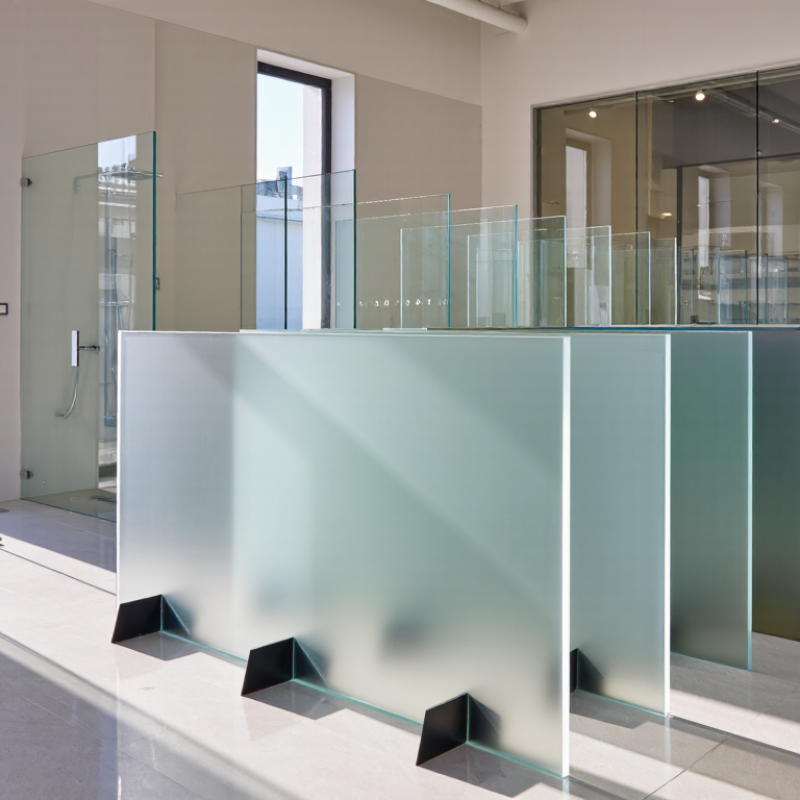
How to Choose Custom Glass for Your Project

Define Your Project’s Functional and Design Requirements

Define the job before choosing the appearance. Is the glass meant to admit daylight, separate a shower, reduce glare, or protect a tabletop? Note nearby heat sources, moisture, foot traffic, and cleaning habits. Measure the opening in several places; older walls are rarely perfectly square. Measure twice.

Then set practical requirements with the fabricator. Glass thickness, edge finish, support, and fixing method all affect performance. A shower panel needs suitable hardware and carefully finished edges. For overhead or impact-prone locations, ask a qualified professional to specify an appropriate safety-glazing construction and confirm local building requirements. Tempered glass cannot be cut after heat treatment, so dimensions and holes must be settled before fabrication.

Design choices should follow those constraints, not fight them. Clear glass keeps a room open, while patterned or frosted glass offers more privacy. Tint and coatings can change both light transmission and color, so view a sample in the actual room, beside its tile or paint. Samples can mislead under showroom lighting. It is easy to focus on appearance and overlook cleaning: textured surfaces may show mineral deposits more readily. If the use is uncertain, describe the room and daily conditions to the fabricator, and ask what assumptions still need checking.

Compare Glass Types for Strength, Clarity, and Performance

Custom glass selection starts with the demands of the opening: impact risk, sunlight, privacy, and cleaning. Annealed glass offers clear, economical glazing, but it breaks into larger, sharper pieces. For doors, sidelights, and exposed areas, fully tempered glass is often a stronger option. National Glass Association technical guidance describes tempered glass as about four times stronger than annealed glass of equal thickness. It also breaks into smaller fragments, though it is not unbreakable. Laminated glass uses a plastic interlayer to hold many fragments in place after breakage. That can be useful near stairs or overhead, where falling pieces are a concern. Installation and edge quality matter, too.

Clarity and energy performance can pull in different directions. Low-iron glass reduces the green tint visible along thick edges, making it useful for display cases or pale stone interiors. Low-emissivity coatings can limit heat transfer, but the right coating depends on orientation and climate. The U.S. Department of Energy’s Energy Saver guidance estimates that windows account for 25–30% of residential heating and cooling energy use. That figure makes glazing worth careful comparison, not guesswork. Ask for the proposed glass thickness, safety classification, and NFRC-rated U-factor and solar heat gain coefficient. There is no perfect pane. I still find appearance samples under real daylight more revealing than catalog images.

How to Choose Custom Glass for Your Project - Compare Glass Types for Strength, Clarity, and Performance

Glass Type Strength and Impact Typical Clarity Breakage and Safety Thermal Performance Common Applications
Annealed Clear Float Baseline strength for common soda-lime glass; relatively vulnerable to impact and edge damage. About 88% visible light transmission for clear glass around 6 mm thick; transmission decreases as thickness increases. Breaks into large, sharp shards. Not safety glazing where impact protection is required. Offers little resistance to rapid temperature changes compared with borosilicate glass. Insulation depends mainly on glazing design. Picture frames, cabinet doors, and other locations where safety-glazing requirements do not apply.
Heat-Strengthened Glass Typically about twice the mechanical strength of comparable annealed glass; more resistant to thermal stress. Usually similar to the equivalent clear annealed glass, with a slight appearance variation possible. Breaks into larger pieces than fully tempered glass. It is generally not classified as safety glazing on its own. Improved resistance to thermal stress, but not as high as fully tempered glass. Building façades and other applications needing increased strength where a safety-glass break pattern is not required.
Fully Tempered Glass Typically about four times as strong as comparable annealed glass in bending; actual capacity depends on thickness, size, and edge quality. Generally similar light transmission to the same clear glass before tempering; small optical distortions can occur. When broken, it usually fragments into many small pieces. Commonly used as safety glazing where required by code. Better resistance to thermal stress than annealed glass; does not provide significant insulation by itself. Shower enclosures, doors, partitions, and other locations exposed to human impact or temperature variation.
Laminated Glass Strength varies with the glass plies and interlayer; the interlayer helps keep the assembly together after breakage. Clear laminates retain good visibility; interlayers may slightly reduce transmission or add color, depending on specification. Broken fragments generally adhere to the interlayer, helping maintain a barrier. Suitable configurations can meet safety-glazing requirements. Standard laminated glass is not a substitute for an insulated glass unit; specialized interlayers can improve sound control. Overhead glazing, guards, skylights, security glazing, and locations where retaining broken glass is important.
Low-Iron Glass Strength is comparable to ordinary glass of the same composition, thickness, and processing; low iron does not itself strengthen glass. Often exceeds 90% visible light transmission in common architectural thicknesses, with less green tint at the edges. Safety depends on whether the glass is tempered or laminated; low-iron glass alone is not safety glazing. Thermal insulation is similar to comparable clear glass; coatings or insulating units are needed to change energy performance. Display cases, glass doors, balustrades, and projects where neutral color and high transparency matter.
Borosilicate Glass Mechanical strength depends on product design and thickness; it is not automatically stronger against impact than tempered soda-lime glass. Clear grades can provide high light transmission; exact performance varies by thickness and product. Breakage behavior depends on processing and construction. Specify safety treatment where impact protection is needed. Has a low thermal expansion rate and generally handles rapid temperature changes better than ordinary soda-lime glass. Laboratory equipment, cookware, lighting components, and other applications with significant temperature cycling.

Selection note: Figures are typical estimates for clear, uncoated glass and are not product guarantees. Strength, light transmission, and safety performance vary with thickness, dimensions, edge condition, processing, coatings, and assembly. An insulated glass unit is a glazing assembly—not a glass type—and its thermal performance depends on the complete unit design.

Choose Glass Thickness, Size, and Structural Support

How to Choose Custom Glass for Your Project
Choose Glass Thickness, Size, and Structural Support

Start with the panel’s purpose and the conditions around it. A glass shelf holding books needs different support than a decorative cabinet door. Thickness depends on the glass type, panel dimensions, span, edge treatment, and expected load. Thicker glass is not automatically the safer choice. A wide shelf may still flex if it has too few supports. Measure the opening at several points; walls and frames are rarely perfectly square. Measure twice.

Before ordering, confirm how each edge will be supported. Glass set into a frame behaves differently from a panel fixed with clamps or stand-offs. Large panels may need stronger hardware or additional support, and holes or cut-outs can affect strength. Ask a qualified glass professional to review the dimensions, intended use, and installation details. For overhead or safety-critical applications, get project-specific guidance rather than relying on a general thickness chart. Plans sometimes change after measuring, and that is worth catching early.

Tips: Share clear measurements, photos of the installation area, and the expected load. Check that hardware suits the glass thickness, and leave room for installation tolerances. Small details matter.

Select Surface Treatments, Edges, and Custom Fabrication

How to Choose Custom Glass for Your Project
Select Surface Treatments, Edges, and Custom Fabrication

Custom glass works best when its finish suits the room, not just the drawing. Acid-etched surfaces soften views and diffuse light, while clear glass preserves sharp sightlines. Low-emissivity coatings can help manage heat transfer, but coating choice and placement should match the glazing assembly. Think about cleaning, glare, and what people will see reflected in the glass. Small details matter.

The U.S. Department of Energy’s Energy Saver guidance estimates that heat gain and loss through windows account for 25–30% of residential heating and cooling energy use. That figure applies to windows, not every interior glass feature. Still, it shows why surface selection can affect more than appearance. Ask your fabricator to confirm coating compatibility, light transmission, and the intended installation before approving samples.

Edges change both appearance and handling. A polished edge suits exposed shelves or partitions; a seamed edge may work when the frame conceals it. Specify holes, notches, and final dimensions before heat treatment, since later cutting can break tempered glass. Bring a full-size template for unusual cutouts, and check clearances around hinges and hardware. Edge choice is easy to underestimate. A small mismatch can make installation awkward, and mock-ups are not always perfect.

How to Choose Custom Glass for Your Project

Compare common surface treatments, edge finishes, and fabrication details by their relative planning complexity.

Scores use an indicative 1–5 planning scale, not measured production data. Actual complexity depends on glass type, thickness, dimensions, tolerances, and the fabricator’s process. Confirm requirements before specifying the glass.

Check Safety Standards, Installation Needs, and Maintenance

How to Choose Custom Glass for Your Project

Check Safety Standards, Installation Needs, and Maintenance

Start with the glass’s location and likely impact. Doors, low windows, and shower enclosures may require safety glazing under local codes. In the United States, check whether the product meets CPSC 16 CFR Part 1201 or ANSI Z97.1 requirements. Tempered glass breaks into small pieces, while laminated glass holds fragments together. The right choice depends on the opening, frame, and project requirements. Confirm the specification before ordering.

Installation details matter just as much. A few millimeters can affect fit, so measure the opening after the frame is installed. Tell the glazier about exposed edges, heavy hardware, and changing temperatures. I still double-check clearances; it is easy to overlook them on a drawing. The U.S. Department of Energy estimates that windows account for about 25–30% of residential heating and cooling energy use. That makes glazing type and airtight installation practical energy considerations, not just aesthetic ones.

Plan for upkeep, too. Ask whether the finish needs special cleaning and how often seals should be inspected. Use non-abrasive cloths, and watch for cracked sealant, loose fittings, or moisture between panes. Small signs matter. A maintenance plan may seem fussy, but missed seal damage can become a costly repair. Check the manufacturer’s care instructions and local code before finalizing the glass.

FAQS

What should I decide before choosing a glass style?

Define the purpose first: daylight, privacy, splash protection, or a display surface. Note moisture, nearby heat, foot traffic, and cleaning habits. Looks can distract.

How should I measure a glass opening?

Measure the width and height in several places. Older walls and frames may not be square. Measure twice.

How do I choose the right glass thickness?

Thickness depends on panel size, glass type, span, edge treatment, support, and expected load. A thicker panel is not automatically safer. Ask a qualified glass professional to review the details.

What should I check for a shower panel or overhead glass?

Confirm the glass construction, hardware, support, and finished edges suit the location. Ask a qualified professional to check project details and local building requirements. Guessing here is unwise.

Can tempered glass be cut after fabrication?

No. Dimensions, holes, and notches must be settled before heat treatment. Check hinge and hardware clearances early.

Which surface finish works best for privacy and light?

Clear glass keeps sightlines open. Frosted or patterned glass softens views and diffuses light. View a sample beside the room’s tile or paint; showroom lighting can mislead.

Do coatings affect more than appearance?

Yes. Tint and coatings can change color and light transmission. Low-emissivity coatings may help manage heat transfer, but compatibility depends on the glazing assembly. Confirm the placement with the fabricator.

Which edge finish should I choose?

A polished edge suits exposed shelves or partitions. A seamed edge may work inside a frame. Small mismatches can make installation awkward.

What details should I share before ordering custom glass?

Provide measurements, installation photos, intended use, and expected load. Include a full-size template for unusual cutouts. I might still miss a detail, so check the plan once more.

Conclusion

Choosing Custom Glass begins with understanding how the piece will be used and the look you want to achieve. Consider practical needs such as strength, transparency, privacy, and resistance to heat or impact, then compare suitable glass types. The right option should balance appearance with the demands of its setting.

Next, determine the appropriate thickness and dimensions, along with any structural support needed for a secure fit. Decide whether surface treatments, polished or shaped edges, or other custom fabrication details will improve the result. Before installation, check that the glass meets relevant safety requirements and that the surrounding structure can support it. Planning for careful handling, suitable installation, and straightforward cleaning will help your finished project remain functional and attractive over time.

Ethan

Ethan

Ethan is a professional marketer with a strong understanding of the company’s products and the needs of the customers they serve. He combines product knowledge with clear, practical communication, helping readers understand how different solutions work, what they offer, and how to choose options......