Toughened Glass is not one product but a family of heat-treated and chemically strengthened materials. The National Glass Association’s technical guidance describes fully tempered glass as roughly four times stronger than annealed glass of the same thickness. It also explains its characteristic breakage: small, relatively blunt fragments rather than long, sharp shards. That feature can reduce injury risk, but it does not make every installation safe by itself.
The categories matter. Fully tempered glass suits doors, shower enclosures, and side panels exposed to impact. Heat-strengthened glass offers greater resistance than annealed glass, but it is not equivalent to fully tempered glass. Chemically strengthened glass can retain a thin, smooth profile, while laminated constructions hold fragments together after breakage. ASTM C1048 covers heat-treated flat glass; ANSI Z97.1 and CPSC 16 CFR Part 1201 set impact-performance requirements for safety glazing. Details matter. Thickness, edge quality, framing, and installation can change real-world performance.
Glass scientist John C. Mauro has described glass as “a state of matter, not a material.” The phrase is a useful reminder: processing and composition shape performance, not appearance alone. This overview compares the leading types by strength, breakage behavior, applications, and limitations. Some product claims blur important distinctions. A reflective glass panel may look robust, yet its edges or support system can remain vulnerable. No single type is best for every project.
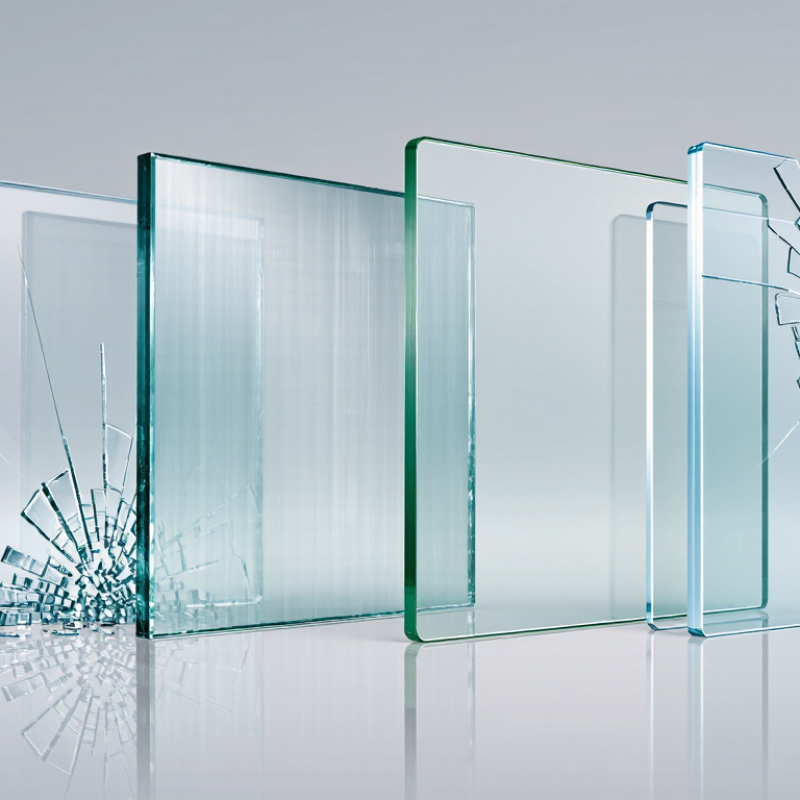
What Defines Toughened Glass and How Is It Strengthened?
Toughened glass, also called tempered glass, is ordinary glass treated to resist impact and temperature changes better. The process begins after cutting and shaping, because the finished panel cannot be trimmed or drilled safely. Small details matter. A poorly finished edge can become a weak point.
The glass is heated to roughly 620°C, then cooled rapidly with controlled air jets. Its outer surfaces cool and contract before the warmer center does. This leaves the surfaces under compression and the core under tension. That internal balance helps the pane withstand greater bending and impact forces than untreated glass. Exact performance depends on thickness, dimensions, edge quality, and manufacturing control.
If it breaks, toughened glass usually separates into many small pieces rather than large, sharp shards. “Usually” matters: fragments can still cut, and the glass is not unbreakable. Its strength also depends on proper installation; tight hardware or pressure against a hard frame can create stress. One limitation is easy to overlook: scratches and edge damage may weaken a panel, even when the center looks flawless. A careful visual check helps, but it cannot reveal every internal stress.
What Are the Top Types of Toughened Glass?
Minimum surface-compression benchmarks for common heat-treated glass types
Toughened glass is strengthened by creating surface compression and interior tension. Under ASTM C1048 benchmarks, heat-strengthened glass has a minimum surface compression of 24 MPa, while fully tempered glass has a minimum of 69 MPa. Chemical strengthening is also used, but its compression levels vary by glass composition and process, so it is not included in this standardized comparison.
How Does Fully Tempered Glass Differ from Heat-Strengthened Glass?
Fully tempered and heat-strengthened glass are both heat-treated, but they serve different needs. ASTM C1048-18(2023) sets surface-compression ranges of 10,000 psi or more for fully tempered glass, compared with 3,500–7,500 psi for heat-strengthened glass. That gap matters. Fully tempered glass is stronger under impact and thermal stress, and typically breaks into many small fragments. Heat-strengthened glass is less heavily compressed and usually breaks into larger pieces.
The choice affects what happens after breakage. In a door or shower enclosure, fully tempered glass may reduce the risk of large, sharp shards, though fragments can still cause injury. Heat-strengthened glass often stays in the frame longer after cracking, making it useful in some glazed assemblies where post-breakage retention matters. It is not a simple “strong versus weak” choice. Frame design, glass thickness, edge quality, and installation all matter. I find the distinction easy to underestimate when comparing only the glass itself.
Tips: Check the project specification for the required glass type and thickness. Ask whether the assembly needs fragmentation or better retention after cracking. Don’t rely on appearance alone; the two types can look identical.
What Are the Main Types of Chemically Strengthened Glass?
Chemically strengthened glass is made by exchanging smaller ions near the surface for larger ones. The larger ions press against the surrounding glass, creating a compressive layer that helps resist scratches and impacts. The glass is not heated until it softens, as in thermal tempering. Its shape and optical clarity can therefore be better preserved.
The most common type uses potassium ions to replace sodium ions in sodium-containing glass. This process is often called potassium-for-sodium ion exchange. Another route replaces lithium ions with sodium ions in lithium-containing glass. The suitable method depends on the glass composition; these processes are not interchangeable. The details matter.
A second way to distinguish products is by the number of exchange stages. Single-stage treatment is simpler, while multi-stage treatment can be designed to adjust the depth and stress profile of the strengthened layer. Results depend on salt-bath temperature, treatment time, and the glass itself.
A thicker compression layer does not automatically mean a stronger finished part. Edge damage, holes, and cutouts can still become weak points. The label alone tells me less than I would like; manufacturers’ test data and the intended use matter when comparing glass.
How Do Curved and Patterned Toughened Glass Differ?
Curved and patterned toughened glass solve different design problems. Curved glass is heated until pliable, bent over a shaped mold, then rapidly cooled to hold its form. It suits rounded shower enclosures, balustrades, and display cases, where an arc changes sightlines and reflections. Patterned toughened glass instead has a textured surface, such as fine ribs or a hammered finish, to diffuse light and soften views. Its appeal is privacy and tactile detail, not geometry. Texture can make cleaning harder.
Both can be safety glass, but their processing and inspection needs differ. ASTM C1048-22 specifies a minimum surface compression of 69 MPa (10,000 psi) for fully tempered glass. This is a performance threshold, not a guarantee against breakage. Curved units need careful control of radius, thickness, and optical distortion; patterned panes need the textured face and coating orientation confirmed before fabrication. Small fragments matter. Tempering generally causes glass to break into many small pieces, yet edges and holes remain vulnerable to damage. Ask fabricators for heat-treatment records, dimensional tolerances, and samples viewed in daylight. I’d inspect a full-size sample when appearance is critical; reflections can look less perfect than drawings suggest.
What Are the Top Types of Toughened Glass? - How Do Curved and Patterned Toughened Glass Differ?
| Type |
How It Is Made |
Key Characteristics |
Common Applications |
Important Considerations |
| Flat toughened glass |
Flat glass is heated to a high temperature and rapidly cooled with controlled air jets. |
Stronger and more resistant to thermal stress than comparable annealed glass. When it breaks, it generally fragments into many small pieces rather than large sharp shards. |
Doors, partitions, shower enclosures, façades, and side or rear vehicle glazing where permitted by applicable requirements. |
Cutting, drilling, and edge work must normally be completed before tempering because post-tempering alteration can cause breakage. |
| Curved toughened glass |
The glass is heated until it can be formed to a designed curve, then rapidly cooled to create the toughened condition. |
Its defining feature is its curved shape. It can be clear or have a coated finish; the surface is not necessarily textured. |
Curved façades, rounded storefronts, display cases, balustrades, and architectural screens. |
Radius, dimensions, thickness, and permitted optical distortion depend on the production method and project specification. Confirm the curve and installation tolerances before ordering. |
| Patterned toughened glass |
Textured or patterned glass is heat-treated, provided the glass composition, pattern, and dimensions are suitable for the tempering process. |
Its defining feature is a patterned or textured surface, which can diffuse light and reduce clear visibility. The panel is usually flat, but pattern alone does not determine its shape. |
Privacy screens, internal doors, partitions, and decorative glazing. |
Pattern depth and orientation can affect appearance and processing. Check which face is patterned and confirm that the specific product is suitable for toughening. |
| Heat-soak-tested toughened glass |
After toughening, panels undergo a controlled heat-soak process intended to trigger some inclusions that could otherwise cause spontaneous breakage. |
This is an additional treatment and test, not a separate surface pattern or shape. It can be specified for suitable flat or curved products. |
Projects where reducing the risk of spontaneous breakage is a design consideration, including some overhead or façade glazing. |
Heat soaking reduces but does not eliminate the risk. Specify the applicable standard and documentation for the project. |
Key difference:
Curved describes the glass's geometry; patterned describes its surface texture. They are different characteristics, so a product may be curved, patterned, or—where manufacturing allows—both. Toughened glass is not automatically safety glazing for every application; confirm the required product standard, thickness, support, and local building requirements.
Which Type of Toughened Glass Suits Different Applications?
Choosing toughened glass starts with the way it may fail, not simply its strength. Fully toughened glass suits shower screens, patio doors, and side panels where impact resistance matters. When it breaks, it usually separates into small fragments, but the opening is no longer protected. Keep that in mind near floor-level edges.
Laminated toughened glass combines heat-treated panes with a plastic interlayer. It is useful for overhead glazing, balustrades, and shopfronts where broken pieces should remain attached. The interlayer helps retain fragments, though the panel may still need replacement. Curved toughened glass can fit rounded façades or display cases, but its shape must be planned before tempering. It cannot usually be cut afterward.
Not every job needs maximum strength. Heat-strengthened glass is less resistant than fully toughened glass, but may suit some façades where thermal stress is a concern. It is not a direct substitute where safety glazing is required. Fit matters. Check panel size, edge support, nearby hardware, and likely temperature changes with a qualified glazing professional. A common mistake is treating “stronger” as a complete specification; the right choice depends on how the glass is supported and what should happen if it breaks.
Conclusion
Toughened Glass is glass that has been treated to improve its strength and resistance to impact and temperature changes. It is commonly strengthened through controlled heating and rapid cooling, which creates a durable surface and changes how the glass behaves if it breaks. Fully tempered glass is stronger than heat-strengthened glass and typically breaks into smaller pieces, while heat-strengthened glass offers a moderate increase in strength and tends to form larger fragments.
Chemical strengthening is another approach: ion exchange can create a compressive surface layer, with different methods suited to varying thicknesses and performance needs. Toughened glass can also be curved to fit rounded designs or patterned to add texture, privacy, or visual interest. Choosing the right type depends on the application, including the required strength, shape, appearance, and safety performance. By considering these factors, designers and builders can select glass suited to uses such as doors, partitions, façades, and decorative features.