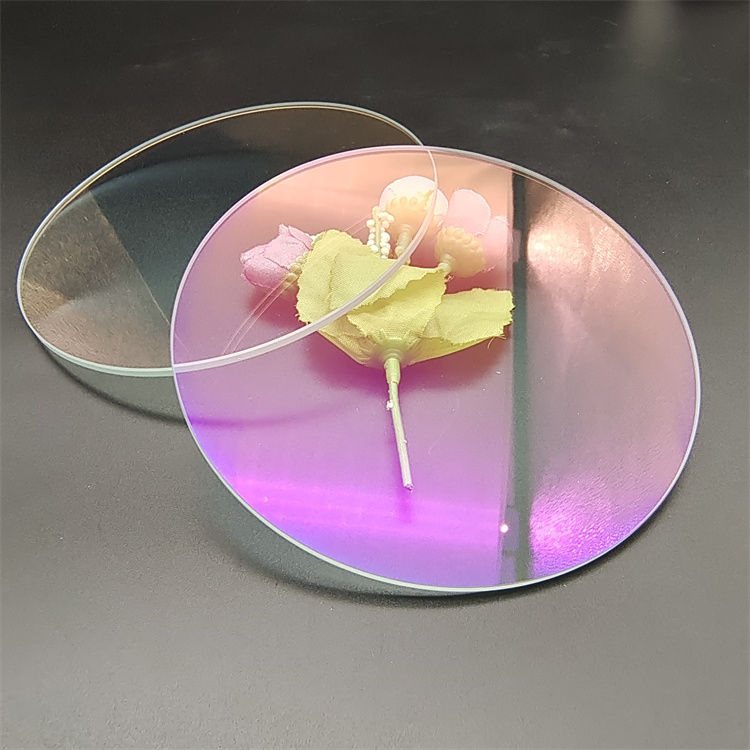
AR Coated · 1–6 mm
Premium Quality Ultra Clear Anti Reflective Solid High Strength 1mm 2mm 3mm 4mm 5mm 6mm Flat Tempered Glass Coating
Tempered · Low reflection
Price is the easiest variable to compare and the least useful one to decide on. The manufacturers that survive a five-year supply relationship are the ones that hold tolerances, repeat colour, and answer engineering questions before samples are cut.
Searches for top China glass plate manufacturers & factory rarely come from someone who wants a catalogue. They come from a design engineer or a sourcing manager holding a drawing — a 1.1 mm ultra-clear cover plate for a wall switch, a 3 mm tempered window for an industrial HMI, a 10 mm round glass disc with a high-temperature ceramic border for a downlight. The real question behind the search is narrower: who can turn this drawing into 5,000 identical parts, on schedule, without the colour drifting between batches?
China's glass processing cluster answers that question better than any other region, not because labour is cheap — it no longer is — but because the process chain is physically concentrated. Float glass, CNC shaping, edge polishing, hole drilling, tempering furnaces, silk-screen and ceramic printing lines, anti-glare etching and AR / AF vacuum coating all sit within a few hours' drive of each other in Guangdong, Jiangsu and Zhejiang. Dongguan, where the electronics supply chain is densest, sits at the centre of that network.
Concentration matters more than most buyers realise. Every time a glass plate leaves one workshop for another, it is packed, unpacked, transported and re-inspected. Edges chip, surfaces scuff, and printed colour shifts under a different curing profile. A factory that performs cutting, tempering, printing and coating under one roof removes four handling cycles — and four chances for a defect to enter the batch. That is the structural advantage worth paying for, and it is the single most useful filter when shortlisting suppliers.
This whitepaper covers the product families most frequently sourced from China, the process capabilities that separate a genuine factory from a trading desk, the optical treatment matrix (AR vs AG vs AF vs ultra-clear), the product and procurement trends shaping the next five years, and the practical screening questions that predict whether a supplier will still be answering your emails in year three.
Every item below is produced to drawing — thickness, outline, corner radius, hole position, printing colour and surface treatment are all customisable. Thickness runs from 0.2 mm electronic-grade glass to 19 mm flat tempered plate.
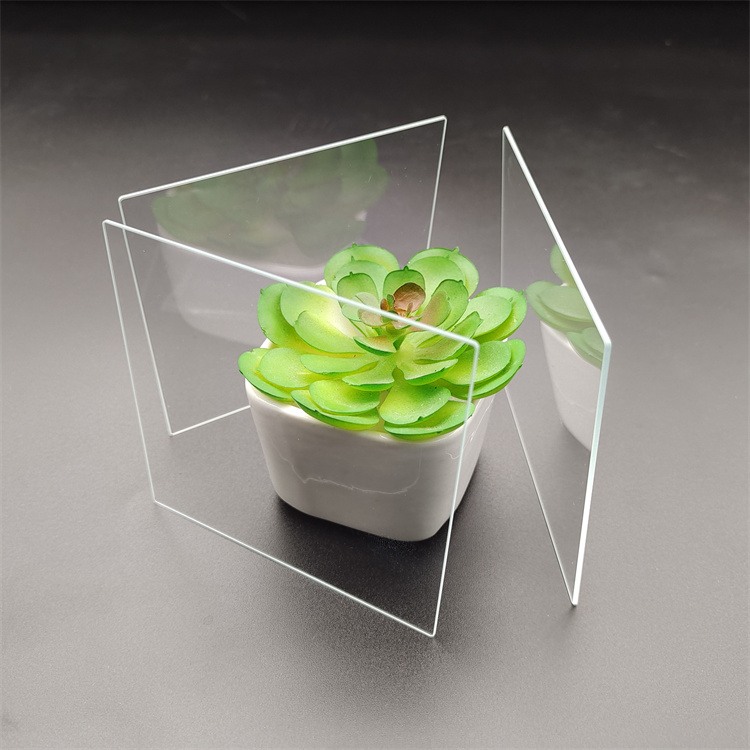

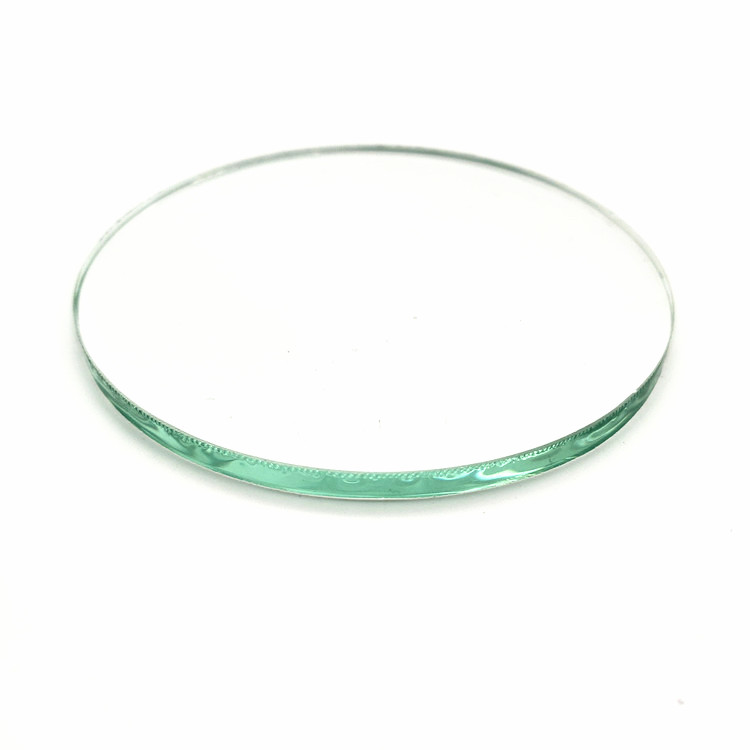
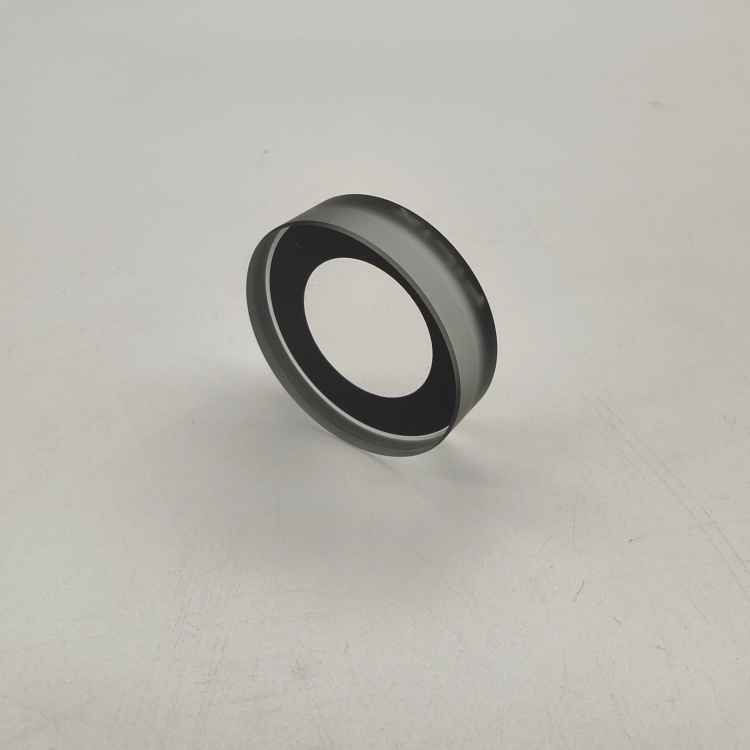

A real glass plate factory keeps the critical steps in one building. Every outsourced step adds a handling cycle, a tolerance stack-up and a reason to blame someone else when a batch fails inspection.
Automatic sheet cutting plus CNC routing for rounds, notches, slots, stepped outlines and irregular decorative shapes — the first step that decides whether the finished part fits the housing.
Pencil, flat, bevel, stepped and matte edge profiles. Polishing removes micro-chips that later become crack initiation points during tempering and transit.
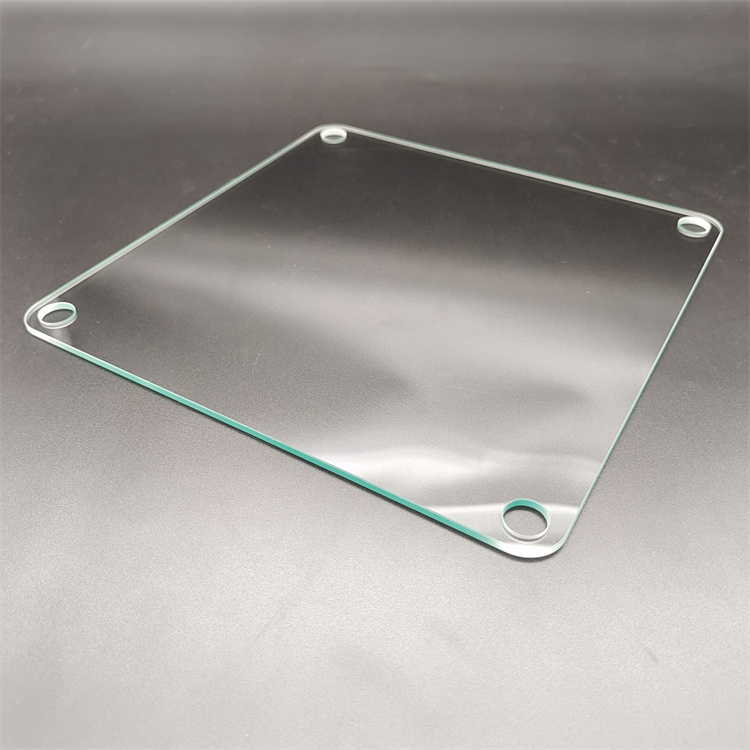
Openings for buttons, sensors, camera lenses, knobs and mounting screws — drilled before tempering so the stress field stays intact around each aperture.
Furnace strengthening raises impact resistance roughly four to five times over annealed glass and produces the small, blunt fragmentation pattern required for safety-critical covers.
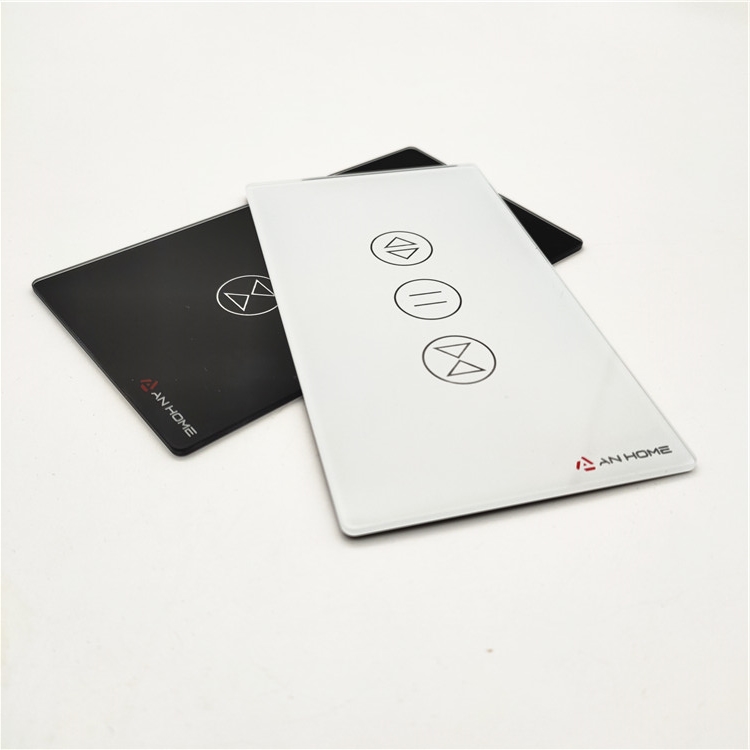
Multi-colour logos, icons, borders, gradient masks and transparent display windows. Ceramic ink is fired at high temperature, so it bonds to the glass rather than sitting on top of it.
A controlled matte surface that scatters reflected light. Haze level is matched to viewing distance — finer haze for high-resolution panels, coarser haze for outdoor signage read from metres away.
A multilayer optical stack that suppresses surface reflection and lifts transmission. Double-sided coating delivers the largest gain and is the default specification for medical, industrial and camera-adjacent displays.
An oleophobic top layer applied last in the coating stack. It improves finger glide, resists oil and sweat marks, and makes touch surfaces far easier to clean in daily use.
Most sourcing mistakes are specification mistakes, not manufacturing mistakes. Use this matrix during design review — treatments can be combined, for example AG plus AF on an outdoor touch kiosk.
| Glass Type | Problem It Solves | Typical Applications | Engineering Note |
|---|---|---|---|
| Ultra Clear (Low-Iron) | Removes the green tint of ordinary float glass so product colours read true | Display covers, LED lamp glass, premium appliance panels | Pair with white or light printing — standard float glass shows a green edge that no ink can hide |
| AR Anti-Reflective | Cuts surface reflection, raising contrast and useful light transmission | Medical and industrial monitors, instrument windows, camera covers | Specify single or double-sided; double-sided gives the largest measurable gain |
| AG Anti-Glare | Scatters harsh reflections from sunlight or overhead fixtures | Outdoor kiosks, vehicle HMIs, industrial controllers, digital signage | Match haze percentage to viewing distance — too coarse and fine text loses definition |
| AF Anti-Fingerprint | Repels oil and sweat so touch surfaces stay visually clean | Capacitive touch panels, smart switches, POS terminals | Applied as the final layer over AR or AG — sequence matters more than thickness |
| Silk-Screen Printed Tempered | Hides internal wiring while adding logos, icons and display windows | Wall switch plates, appliance controls, instrument panels | Supply Pantone codes plus the exact transparent window size on the drawing |
Final optical values depend on substrate, thickness and coating stack. Always approve a physical sample under your own lighting conditions before releasing a mass-production order.
Design roadmaps in consumer electronics, lighting and smart home are pushing glass plates thinner, optically cleaner and more functionally integrated. These six directions are already visible in live quotation requests.
Sub-millimetre cover glass down to 0.2 mm is moving from prototype to volume in wearables, thin wall switches and compact LED fixtures, where every gram and every millimetre of thickness is designed out.
Single-function coatings are giving way to layered optical stacks that manage reflection, glare and contamination together. Buyers now specify performance targets rather than individual treatments.
Smart home and hospitality control panels increasingly combine printed icons, hidden capacitive windows and tinted decorative finishes on a single tempered plate — one part replacing a plastic housing assembly.
Brighter, denser backlight arrays demand cover glass with lower absorption and tighter thickness control, so that local dimming contrast is not diluted by the front plate.
Matt-anti-glare, gradient fades, hairline metallic effects and fine dot patterns turn the glass plate from a protective window into a visible surface finish — especially in premium appliances and lighting.
Glass is inherently recyclable; the pressure is on the process chain — water recycling in edging and etching, lead-free inks, and thinner substrates that cut both raw material and freight weight.
The purchasing behaviour around custom glass has shifted decisively in the last few years. Suppliers who still only quote on a standard catalogue are losing ground to factories organised around drawings, samples and repeatable data.
Buyers increasingly send a DXF, DWG or PDF drawing with thickness, edge profile, print layout and annual volume attached, and expect a manufacturability review within a working day. The winning factories are the ones with engineers — not sales staff — doing the first technical reply.
Splitting cutting, tempering, printing and coating across four vendors is being replaced by a single supplier who runs all four. It shortens the lead time, removes re-packing damage, and gives one party clear accountability when the batch is measured against the drawing.
Minimum order quantities of 100–500 pieces have become normal for custom glass, well below the historical multi-thousand-piece thresholds. Buyers validate fit and optics on a small run, then scale — a change that rewards factories with flexible changeover and quick sampling.
Requests for inspection records, batch traceability, colour approval under controlled light, and dimensional reports are now routine. Procurement teams treat third-party trade-platform performance data — response rate, reorder rate, verified status — as a leading indicator, not decoration.
Serious buyers ask which line item drives the price: substrate type, total glass area, number of print passes, hole count, tempering loss rate, or coating stack. A supplier who can explain the cost breakdown is usually a supplier who controls the process.
Risk management now means awarding a minority share to a second qualified factory while keeping the majority with the partner who holds the print files and coating recipe. Consistency of the primary source outweighs small unit price differences.
Interleaved separators, edge protection, moisture barrier and cartons rated for export handling are being written into the specification. A batch that is perfect at the factory gate but scratched on arrival is still a failed batch.
Ask these before you send a drawing. The answers reveal within fifteen minutes whether you are speaking to the people who actually run the machines.
Cutting, edging, drilling, tempering, printing and coating should all be named explicitly. If two or more are outsourced, ask who owns the defect when the batch fails.
Capacity should be expressed in pieces per month alongside the machine count and headcount that produce it — a figure you can reconcile against your own order size.
Technical response time is a proxy for project management discipline. A factory answering in three hours with a manufacturability comment is a different risk class from one answering in three days with a price.
Inspection should happen at more than one station — after cutting, after printing, after coating and before packing. One final inspection cannot catch a defect introduced three steps earlier.
Repeat order rate is the most honest quality metric available. A 26% reorder rate across lighting, electronics and appliance buyers says more than any brochure claim.
Verified supplier status, transaction history and third-party assessment records are checkable facts. Treat unverifiable claims about certifications and clients as marketing until proven otherwise.
Located in Shipai Town, Dongguan, Guangdong — the heart of China's electronics manufacturing belt — Jaswe Glass processes custom tempered, ultra-clear, printed and optically coated glass for display, touch, lighting, switch and electrical equipment applications.
The company operates a 26-machine processing floor staffed by more than 80 skilled workers, with monthly output exceeding 200,000 pieces of processed glass. Cutting, special-shape CNC work, edge polishing, hole drilling, tempering, silk-screen and ceramic printing, anti-glare processing, and AR / AF coating are performed in-house — the full chain from raw sheet to finished cover plate under a single quality system.
That structure directly serves the process requirements this whitepaper describes. When a 1 mm ultra-clear switch plate is printed, tempered and coated without leaving the building, colour consistency and edge quality are controlled by one team rather than negotiated between three. Most of the operators bring more than eight years of hands-on glass processing experience, which is what makes tight-tolerance work — 0.2 mm electronic-grade cover glass, multi-colour printing with transparent display windows, hole arrays on small round discs — repeatable rather than dependent on luck.
The portfolio spans tempered glass from 0.2 mm to 19 mm, ultra-clear low-iron display covers, silk-screen printed switch and appliance panels, AR anti-reflective coated glass, AG anti-glare glass, AF anti-fingerprint touch surfaces, LED lighting covers in round, linear and panel formats, and instrument windows for electrical equipment. Thicknesses of 0.5, 0.7, 1, 2, 3 and 4 mm are the most frequently requested for display and touch applications; small-diameter round glass up to 10 mm thick with fired ceramic printing is produced for lighting fixtures.
Buyer-facing metrics are published rather than assumed: an average response time under three hours, a 96.61% inquiry response rate, and a 26% repeat order rate driven by lighting, electronics and appliance customers across America, Europe and Asia. The operating principle the company states is straightforward — scientific management, careful manufacture, high quality service, striving for excellence.
Send a drawing (DXF, DWG or PDF) with thickness, edge type, printing colours, coating requirement, application and estimated annual quantity. Engineering reviews manufacturability and returns a process route, usually within hours. Physical samples follow for fit, colour and optical approval; mass production then runs with in-process inspection at each station and export-grade interleaved packing for transit protection.
The practical answers that shorten a first inquiry from a week of emails to a single technical exchange.
The working range typically covers ultra-thin electronic-grade glass from 0.2 mm up to 19 mm flat tempered plate. For display and touch covers, the most requested thicknesses are 0.5, 0.7, 1, 2, 3 and 4 mm. Thicker plates of 5–10 mm are common for LED lighting covers, instrument windows and decorative panels, while 10–19 mm suits industrial and architectural-grade applications.
Most custom items start between 100 and 500 pieces, depending on part size, number of print passes and coating requirement. Standard clear tempered pieces can usually be supplied in smaller sample quantities for evaluation before a production order is placed. Smaller MOQs are the practical way to validate fit, colour and optics without committing to tooling-driven volume.
AR (anti-reflective) coating reduces surface reflection and raises light transmission, which improves contrast and brightness. AG (anti-glare) treatment diffuses reflected light so the screen stays readable under strong ambient or outdoor lighting. AF (anti-fingerprint) is an oleophobic top layer that resists oil and sweat on touch surfaces. The three are complementary, not alternatives — AR plus AF, or AG plus AF, are common combinations on one cover plate.
Cutting, CNC shaping, edge polishing, hole drilling, tempering, silk-screen and ceramic printing, AG processing and AR / AF coating. Any step performed outside the factory introduces an additional handling cycle and a tolerance stack-up, and it makes defect accountability ambiguous. Ask a supplier to name each in-house step explicitly rather than describing "full service capability" in general terms.
In pieces per month against machine count and headcount. A representative figure for a mid-sized custom glass processor is more than 200,000 pieces per month across 26 machines and over 80 operators, including tempering furnaces, edge polishing machines, silk-screen printers and automatic cutting lines. Capacities stated without a machine or headcount basis are difficult to verify.
Supply a DXF, DWG or PDF drawing with outline dimensions, thickness, corner radii, hole positions and diameters, edge profile, print layout with Pantone references, transparent window sizes, coating requirement, application and estimated annual quantity. Engineering can then review manufacturability before samples are cut. Reviewing the drawing first avoids sampling errors that cost more time than they save.
Interleaved separators between every piece, edge protection on all four sides, moisture-barrier wrapping and cartons rated for export handling. Glass that is perfect at the factory gate but scuffed on arrival is still a failed delivery — packing specification belongs in the purchase order, not in the supplier's discretion.
Substrate type (standard float versus low-iron ultra clear), total glass area, thickness, tempering yield loss, number of print passes and colours, hole count and complexity, edge profile, coating stack, order quantity and packing specification. A supplier who can break the quotation down along these lines is usually a supplier who understands and controls the process.
Share your specification — thickness, outline, edge type, printing colours, coating requirement and estimated annual volume — and our glass engineers will return a manufacturability assessment and process recommendation before any sample is cut.